


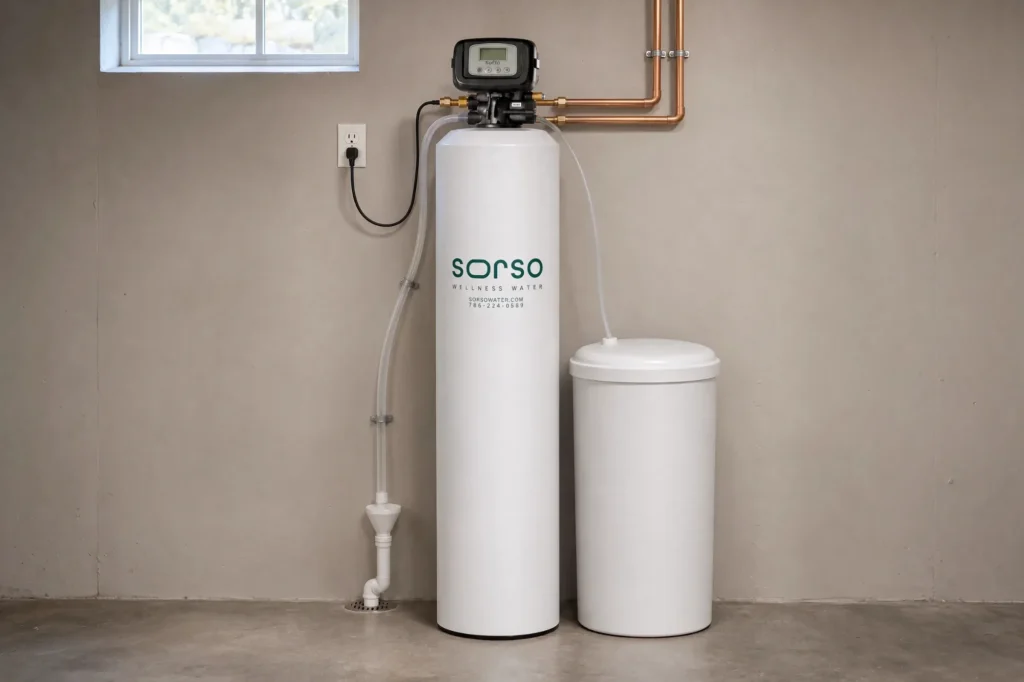
A water softener works by catching calcium and magnesium on thousands of small resin beads. Those beads can only hold so much. When they are full, the softener has to clean them and recharge them before it can soften again. That cleaning cycle is called regeneration.
The short answer: during regeneration, salty water (brine) washes the hardness off the resin and sends it down the drain. It uses about 15 gallons of water, usually runs overnight, and with a metered valve it happens every 1,500 to 2,000 gallons your home uses.
What is water softener regeneration?
Inside the softener tank is a bed of resin beads. Each bead is charged with sodium. As hard water flows through, the beads trade that sodium for the calcium and magnesium in the water. Hard water goes in, soft water comes out.
Over time the beads fill up with hardness and have no sodium left to trade. Regeneration reverses the trade: brine from the salt tank floods the resin, the sodium pushes the calcium and magnesium off the beads, and the hardness is rinsed away. The resin is ready to soften again.
Your softener does not use up its resin. It recharges it, over and over, with salt.
That is also why the quality of the resin matters. 10% cross-link resin, the grade Sorso uses, absorbs more calcium before it needs to regenerate, so it needs fewer cycles.
The 5 stages of a regeneration cycle
Regeneration is not one step. The control valve on top of the tank runs it as a sequence, one stage after the other:
- 1
Backwash
Water flows up through the tank, the opposite of normal. It lifts and loosens the resin bed and flushes trapped sediment out to the drain.
- 2
Brine draw
Salty water is pulled from the brine tank and passed slowly through the resin. This is the recharge: sodium replaces the calcium and magnesium on the beads.
- 3
Slow rinse
Fresh water pushes the brine and the freed minerals through the resin and out to the drain.
- 4
Fast rinse
A quick, strong rinse packs the resin bed back down and clears the last of the brine, so your water does not taste salty.
- 5
Brine refill
The valve refills the brine tank with water, which dissolves salt and has the next batch of brine ready for the next cycle.
While a single-tank softener regenerates, the house is on unsoftened water. That is why the cycle is set for the middle of the night, so you never shower in hard water or run the dishwasher halfway through it.
How often should a water softener regenerate?
It depends on two things: how hard your water is and how much water your home uses. The harder the water and the bigger the family, the sooner the resin fills up. The simple math:
Grain capacity ÷ water hardness = gallons between regenerations
30,000 grain ÷ 15 grains per gallon ≈ 2,000 gallons
A rough guide. Your water test and your valve settings give the real number.The other half of the answer is the valve, because the valve decides when regeneration starts. There are two kinds.
Time clock valves
A time clock regenerates on a fixed schedule, every few days, whether your family used a lot of water or almost none. Away on vacation for two weeks? It still regenerates, and still uses salt and water to clean resin that was never full.
Every 3 days = about 120 regenerations a year
120 × 15 gallons = about 1,800 gallons
Used on a calendar, not on need.Metered valves
A metered valve measures the water your home actually uses and regenerates only when the resin is close to full. In a typical home, that is every 1,500 to 2,000 gallons, depending on the size of your family, the size of your home and how hard your water is.
| Metered valve | Time clock valve | |
|---|---|---|
| When it regenerates | When the resin is close to full | On a fixed schedule |
| While you are away | Waits. No water used, no cycle | Keeps regenerating |
| Water and salt | Used only when needed | Used whether needed or not |
| Busy weeks | Regenerates sooner, stays soft | Can run out before its next cycle |
| Used by Sorso | Yes | No |
Sorso uses metered valves. Your softener regenerates when your water calls for it, not when the calendar does. Less wasted water, less wasted salt, and soft water that stays consistent through busy weeks and quiet ones.
Not sure how hard your water is? That number decides how often your softener should regenerate. Our water test is free.
Book a free water testSigns your softener is not regenerating
When regeneration stops working, the softener keeps letting water through, but the hardness comes back. Watch for these:
- Spots and scale come back. White marks on glasses, faucets and shower doors are the first sign that hard water is getting through.
- Soap stops lathering. Shampoo and dish soap feel weak, and skin and hair feel dry again.
- The salt level never drops. If the salt in the brine tank looks the same for weeks, the softener is not drawing brine.
- A hard crust in the brine tank. Salt can harden into a “bridge” with an empty space under it. The tank looks full, but no brine is being made.
- Water standing high in the brine tank. It can point to a blocked line or a valve problem.
Check the salt first
Often the softener is fine and the problem is in the brine tank: no salt, or a salt bridge. Break up the crust gently, top up the salt, and the next regeneration usually brings soft water back.
If the salt is fine and the water is still hard, the valve, the settings or the resin may need a look. That is a job for a technician.
How to keep regeneration working
- Check the salt once a month. Keep the salt above the water line in the brine tank, and do not let it run out.
- Use clean softener salt. Pellets made for water softeners leave less residue in the brine tank.
- Leave the softener plugged in. The valve needs power to measure your water and run the cycle.
- Test your water now and then. If your water changes or your family grows, the settings may need to change too.
Live in South Florida? See how hard South Florida water is.

Water softener regeneration: the short version
- Regeneration recharges the resin with brine so it can keep removing hardness.
- It runs in 5 stages, uses about 15 gallons of water and happens overnight.
- A metered valve regenerates every 1,500 to 2,000 gallons, only when the resin needs it.
- Hard water coming back usually means a salt problem first. Check the brine tank.
Good regeneration is the kind you never notice. The right resin and a metered valve make it happen only when it should.
Choosing a new softener? Read how to choose the best water softener, or see how it comes together in a Sorso whole-home water system.
Hard water coming back, or not sure your softener is set right? Book a free water test. We will test your water and tell you what your softener should be doing. No pressure, just the right answer.
Book a free water test
 Manufacturer direct pricing